

 อ่านภาษาไทย
First time visiting Phuket Old Town, it was really old with dilapidated houses. There weren't many people walking around in the alleys, and even fewer cars driving through. There weren't as many cafes, restaurants, and hotels as there are now. Soi Romanee was still quiet. I even heard a story from an old woman who said that Soi Romanee used to be a major entertainment district in Phuket.
If you're visiting Phuket, take a walk and take some photos. There's delicious food and cool cafes to sit and sip tea or coffee. Let's go for a walk together with Sookjai on the weekend.

Phuket Museum
Some people say they don't like museums, but that's okay. Stop by and take a picture outside, because these two buildings have been important symbols of Phuket Old Town for a long time.
The two buildings are located on opposite corners of Phang Nga Road. They are now called Phuket Nakhara and Peranakan Nitas, together forming the Phuket Museum, operated by Museum Siam, the same one as Tha Tien. The building on the left has a clock tower called the City View Tower, which used to be the Talat Yai Police Station. The building across the street is one of the first branches of Standard Chartered Bank today.
The growth of the mining business in Phuket was extraordinary, so prosperous that offshore bank branches were established since the era of Phraya Ratsadanupradit Mahison Phakdi (Koh Somby Na Ranong) as the governor of the Phuket Province, around the reign of King Rama V.

Why are the street names in the old town the names of provinces?
That's right, why are there many streets in Phuket Old Town that have the same names as provinces in the South, such as Phang Nga Road, Krabi Road, Satun Road, Ranong Road (or even Soi Takua Pa)?
All of these are the names of cities included in the Phuket Province during the time when Koh Simbi Na Ranong was the governor. When the roads were built to create the shophouses that became Phuket Old Town today, the names of the cities in the administration were used as the names of the streets. In addition to the streets named after the main cities in the South, there are also Bangkok Road and Yaowarat Road.
There are also street names named after important figures in the early Rattanakosin period, such as Damrong Road, which is named after Prince Damrong Rajanubhab, who had a close relationship with Koh Simbi Na Ranong.

On On Hotel
Do you like movies? If you've seen the movie The Beach starring Leonardo DiCaprio, you may have seen this hotel in the movie for a moment, because the On On Hotel scene became Khao San Road in the movie, even though it was actually filmed in Phuket.
The word "On On" is Hokkien and means prosperity. It is a very auspicious word. This hotel was built in 1927 and is recognized as one of the important symbols of Phuket Old Town.

Soi Romanee
Now many people probably know Soi Romanee as a walking street, right? And you're probably familiar with the guy sitting in the dreamcatcher net. This alley is becoming popular with tourists, especially girls who like to dress up and take pictures with the beautiful pink old houses. But knowing the history of this alley will make you shiver. In the era when the mining business was booming, until the World War era, Soi Romanee was called Macau.
In addition to opium and gambling for entertainment, there were also prostitutes from Macau, Japan, and Malaya in the same alley (it is said that there were also Chinese and Korean women!). This area was designated as a zoning area for gray businesses. These types of businesses were forced to be located only on Soi Romanee and Bangkok Road.

But that's the story of the past, because today, Soi Romanee has become a beautiful and valuable old town house. This alley is also the starting point of the Vegetarian Festival, or Jia Chai, which is an important tradition of the people of Phuket, as a result of a major epidemic, just like COVID-19.

See Phuket Street Art
Many people may not know before (because they have never visited) that Phuket also has street art. These paintings are scattered throughout the old town, allowing tourists to travel and collect photos as souvenirs. Take a closer look. They say that the picture above is a street art work by Rukkit Kuanhawate, where the artist has hidden 12 kinds of his childhood snacks.

Phuket Thai Hua Museum
When tin ore was in demand for industry in the United States, many Chinese people turned to Phuket. Almost all of them were Hokkien people who migrated to escape poverty. Some tin miners traded until they became prosperous, becoming several trading families that formed the Phuket Thai Hua Association and jointly supported the establishment of Chinese schools after several Chinese schools in Phuket were closed for political reasons.
The museum building today is the former Thai Hua School.

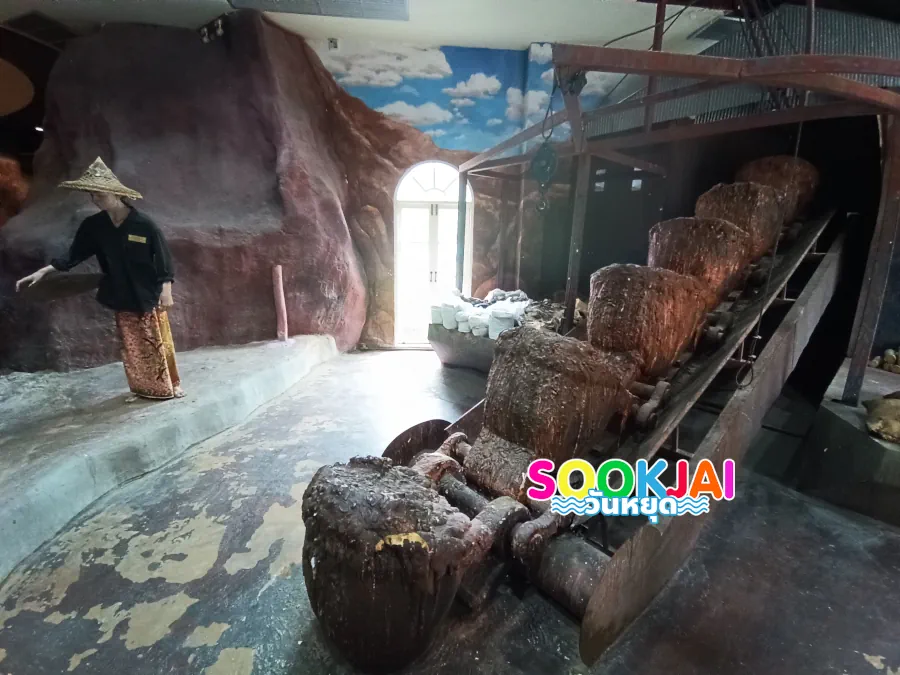
Inside the museum tells the story of the families that can be called the pioneers of Phuket's economy. Each family has a different motto in life, operating businesses in different ways. Some are in the mining business, some make palm oil, some sell cigarettes, some sell rubber varieties, some are in the transportation business, etc. The museum has compiled information into an exhibition for later generations to study the era of pioneering various types of businesses in Phuket.


Another part tells the culture of the Baba Yaya Chinese and also collects stories about the living and eating of the townspeople in detail. For those who are foodies and want to find old restaurants in Phuket, you can travel to collect information before going on a tasting tour from this museum. Guaranteed to be great!

Nguan Soon Tong Pharmacy
Ancient pharmacies and old town houses go hand in hand. If you come to Phuket Old Town, don't forget to take a picture at Nguan Soon Tong, located on Thalang Road. This pharmacy is more than 100 years old. Old people know it as Mae Prik's shop. Notice that it now sells Fisherman's Friend.

Thap Thim Shrine, Hainanese
Thai people call the name Goddess Thap Thim from two very different Chinese gods, but it is believed that Goddess Thap Thim is the guardian of sea travel. One is a real person in history, a god of the Hokkien people before spreading among the Chinese, both Teochew, Cantonese, and Hainanese, with the full name Thian Hou Sian Bo or simply Mazu or shorter, Ama. The other is called Cui Buay Neang (Hainanese called Tui Buay Teng Niang), which means the village at the end of the water.
The Thap Thim Shrine in Phuket Old Town is a Thap Thim Shrine built by the Hainanese people. The original shrine was located in Suriyadej Circle or Fountain Circle near the fresh market. Later, it was moved to Thalang Road, becoming the Hainanese Association in Phuket.

Walk and see old houses, ancient mansions
In addition to the Sino-Portuguese shophouses that can be seen along every street, there are also large houses in the old town called mansions, which are old houses that have been passed down to the present, such as Phra Phitak Chinpracha Mansion (paired with Chinpracha House), Luang Amnat Nararak House, Thaworn Wongwong Family House.

Old Town at Night
When the sun sets, the lights are brightly lit, making the old town at night full of color. There are almost no cars on the streets, inviting you to leave your accommodation and stroll along the main streets, perhaps hiding in a pub or bar for a night that won't be too lonely.


.webp)