

 อ่านภาษาไทย
Wat Ratchaburana, another important temple in the ancient city of Ayutthaya, where Sookjai Weekend will take you back to the events of the great robbery of King Sam Phraya's treasures. Specifically, the gold items that the police were able to recover from the thieves who broke into the crypt beneath the prang were valued at as much as 1,158,270 Baht (according to gold prices in 1956-1957), and this does not even include the massive amount of gold and other treasures that were lost forever.
During the era when Field Marshal P. Phibunsongkhram was Prime Minister, a bowl of noodles cost 50 Satang. Today, that value has increased by approximately 80 times (current noodle price is 40 Baht per bowl). The gold recovered from the robbery was once valued, including a moderate craftsmanship fee, at over 1 million Baht, which translates to 92 million Baht in today's value.
It was truly a massive robbery of Ayutthaya's treasures.


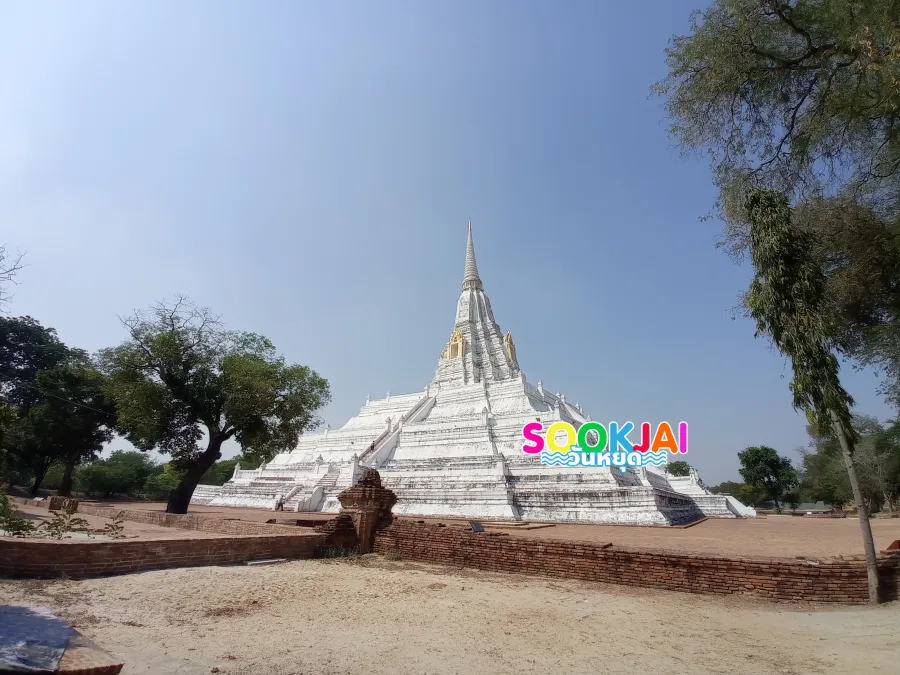
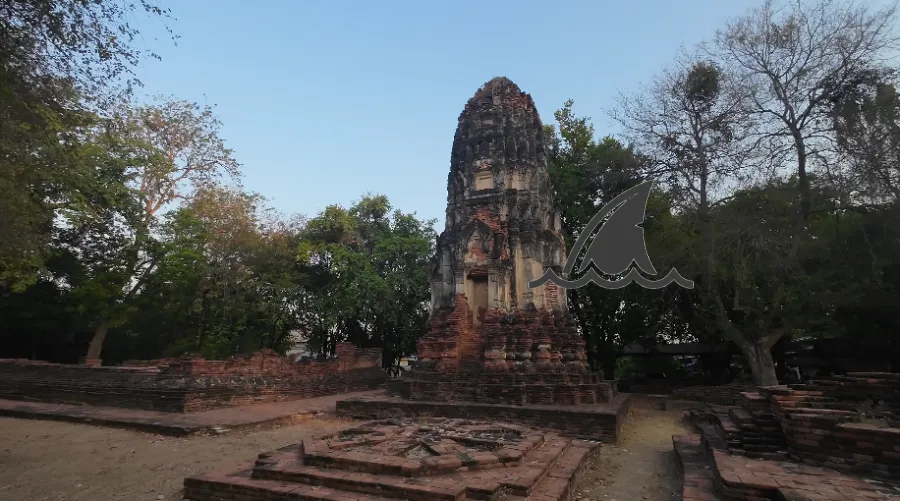
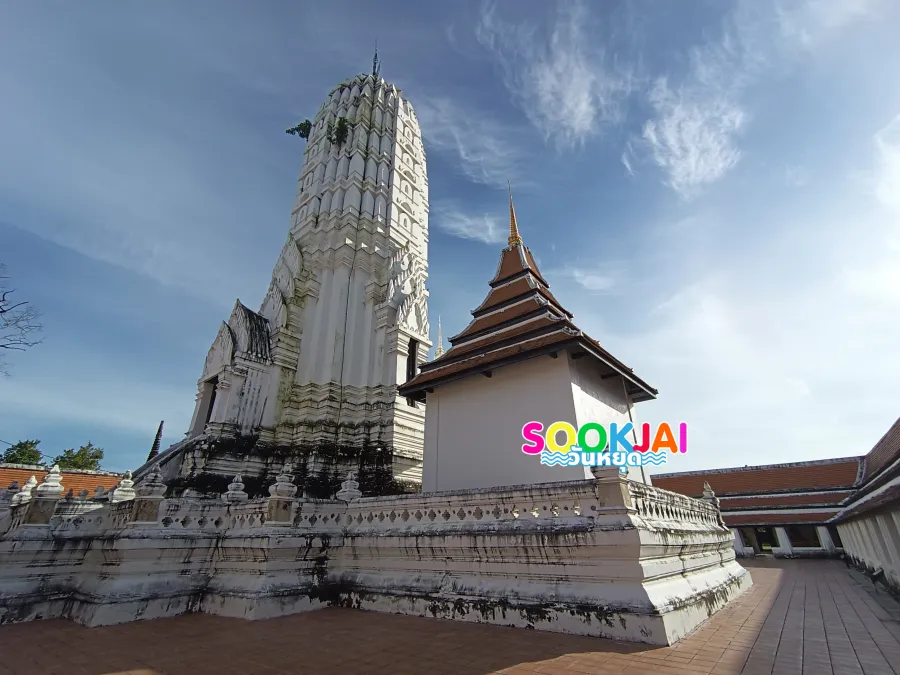
📸 Wat Ratchaburana is located near Wat Mahathat, separated only by Naresuan Road. Naresuan Road is an ancient brick road alignment, originally called Chao Phrom Market Road, connecting to Pa Than Road. Wat Ratchaburana is no less important than Wat Mahathat, as it dates back to the early Ayutthaya period and was also a royal temple. Tourists can take photos of the prominent prang at one of the most important starting points for visiting the ancient city of Ayutthaya. Try taking photos with the Great Vihara (assembly hall), which still has enough well-preserved walls to reveal its past structural grandeur.

In the early Ayutthaya era, during the reign of King Intharacha (the 6th king), after finishing a conflict in the northern cities and returning from Nakhon Sawan (then called Mueang Phra Bang), he appointed his three sons to rule various cities under his power: Chao Ai Phraya ruled Suphan Buri, Chao Yi Phraya ruled Phraek Si Racha (Sankhaburi), and Chao Sam Phraya ruled Chai Nat (Phitsanulok). Later, King Intharacha passed away due to illness, leading Chao Ai and Chao Yi to compete for the throne.

Wat Phlapphla Chai, Pa Maphrao Road
Chao Ai Phraya stationed his army at Wat Phlapphla Chai (Pa Maphrao Road, a name still appearing on current Ayutthaya maps), while Chao Yi Phraya stationed his army at Wat Chaiyaphum, near Chao Phrom Market (maps from the reign of King Rama V never mentioned the name Wat Chaiyaphum). Both princes engaged in an elephant duel with halberds, resulting in both princes striking each other down simultaneously. The court officials then invited Chao Sam Phraya to ascend the throne.

Chao Ai and Chao Yi Chedis
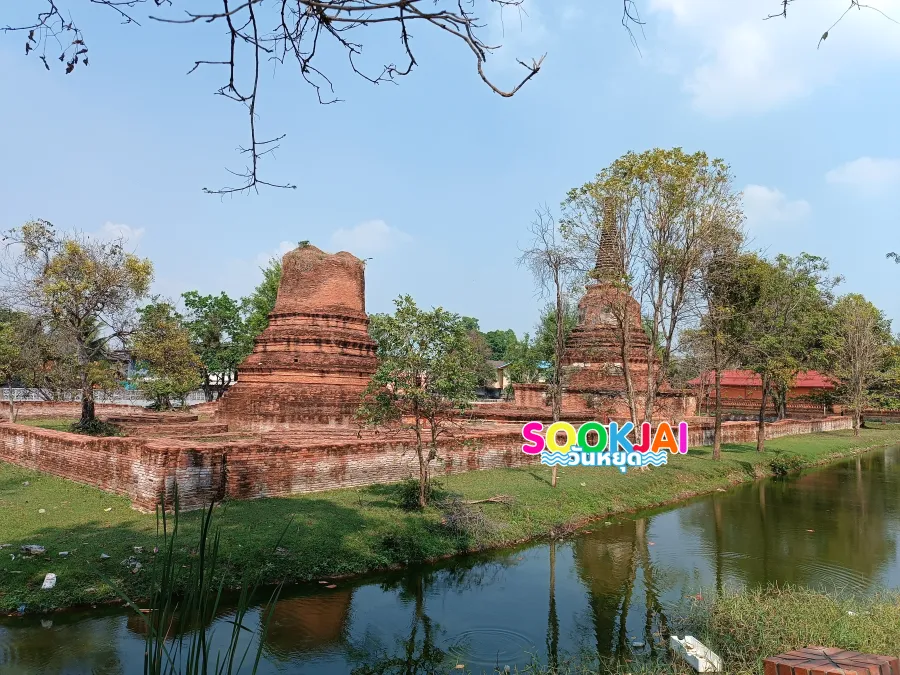
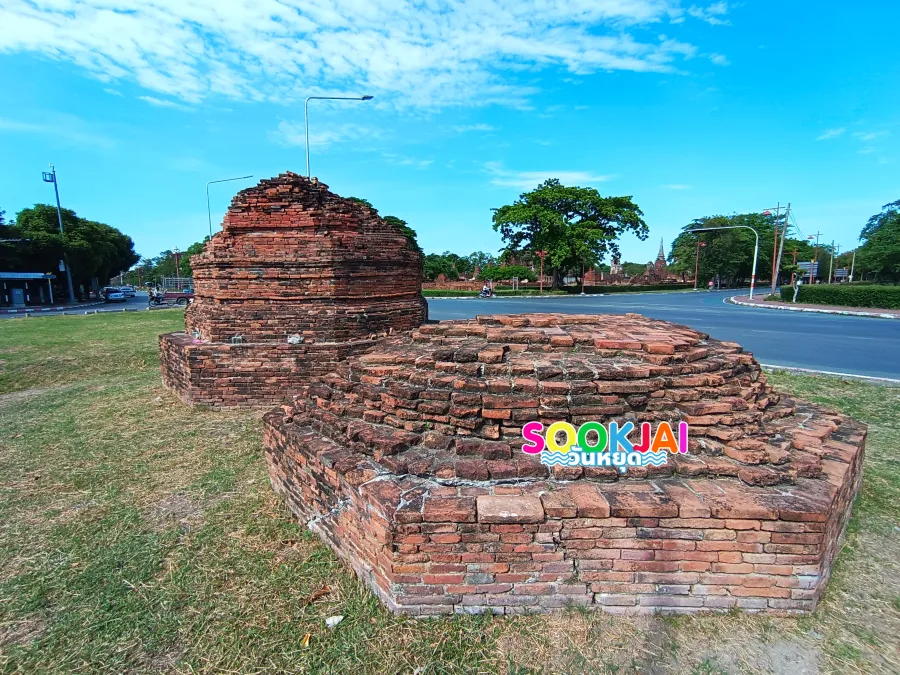
On that occasion, Chao Sam Phraya ordered the bodies of Chao Ai and Chao Yi to be exhumed and cremated. He built two twin chedis at the Pa Than Bridge where the two princes had fought on elephants. Today, the bases of these two chedis remain at the intersection of Naresuan Road and Chikun Road, in front of Wat Ratchaburana. He then ordered the establishment of the Mahathat Prang and Vihara at the site of the cremation and named it Wat Ratchaburana.
The phrase "establishing Wat Ratchaburana" in this context might refer to the formal establishment of a pre-existing temple as the primary royal temple of that reign, with the name "Ratchaburana" being a notable observation for this theory.
During his reign, Chao Sam Phraya led an army to attack the Khmer capital, capturing the city for the third time, causing the Khmer to retreat and move their center to Phnom Penh.


Layout of Wat Ratchaburana, from an illustration in the book "Paintings and Art Objects in the Prang Crypt of Wat Ratchaburana, Phra Nakhon Si Ayutthaya," published by the Fine Arts Department in 1958

Wat Ratchaburana faces East toward Chikun Road (originally a canal connecting Bueng Chikhan or Bueng Phraram, running parallel to the long dirt road out to the city moat to the north). The Great Vihara connects to the cloister in the style of early Ayutthaya temples. The Ubosot (ordination hall) is at the rear, facing West. Within the cloister stands the large main prang. Some suggest it was once a group of three prangs connected by wings (or developed from the three-prang style).

Chedi Number 4, which once featured mural paintings
In the book "Paintings and Art Objects in the Prang Crypt of Wat Ratchaburana, Phra Nakhon Si Ayutthaya," published by the Fine Arts Department in 1958, less than a year after the crypt was excavated, it states that in the niche of the chedi behind the side vihara, north of the Great Vihara, there were once colored mural paintings from the Ayutthaya period (today, this Chedi Number 4 remains only as a base). Prof. Manit Vallibhotama stated that the chedi collapsed 3-4 years prior (from 1957-1958). He cited Prof. Fua Haripitak, who had copied those mural patterns and kept them at Silpakorn University; they were rows of Buddha images painted in the early Ayutthaya style (around 1357 AD).

Around 1957, a major illegal excavation of the treasure crypt occurred, and even police officers were involved in the robbery. Pol. Col. Wut Samutpraphuti of the Ayutthaya Provincial Police reported the incident to the Director-General of the Fine Arts Department. Mr. Krit Inthakosai, Deputy Director-General of the Fine Arts Department, surveyed the crypt personally and recovered as many as 2,121 valuable items. The police assigned the "Be Li Sae" gold shop at Saphan Han to value the gold along with moderate craftsmanship fees. The gold items recovered from the criminals alone were valued at 1,158,270 Baht at that time.
 Chinese inscriptions on a votive tablet of the corner Sema arch, adapted from photos in the Inscriptions in Thailand Database, Princess Maha Chakri Sirindhorn Anthropology Centre

Examples of votive tablets from various chedi crypts in Ayutthaya
Of particular interest was the discovery of Arabic script on gold coins, Chinese inscriptions on votive tablets (mentioning the Damingguo era of China), and a large number of embossed gold votive tablets with inscriptions on the back. The reason so many of these embossed votive tablets were found is that the people of Ayutthaya held the belief of creating votive tablets equal to their age—not by years, but by days. If a person was 1 year old, they would make 365 gold tablets. Therefore, each person who contributed to the prang's crypt had to create tens or hundreds of thousands of tablets. Ultimately, the people of Ayutthaya almost universally hoped for Nirvana and rebirth in the era of Sri Ariya Maitreya (the future Buddha).
With such beliefs, there must have once been hundreds of thousands or even millions of embossed votive tablets in the crypt of Wat Ratchaburana's prang.
Making merit to extend the longevity of Buddhism by burying treasures in chedis was very popular during the Ayutthaya period. This was done with the hope that in the future, if the religion declined, people who discovered the buried gems and gold would use those treasures to build temples and chedis, thereby reviving the Buddhist faith. The people of Ayutthaya considered this a high form of merit.
 King Rama IX and the Queen Mother (Queen Sirikit) observing artifacts from the Wat Ratchaburana prang crypt. Image from the book "Paintings and Art Objects in the Prang Crypt of Wat Ratchaburana, Phra Nakhon Si Ayutthaya," by the Fine Arts Department, 1958
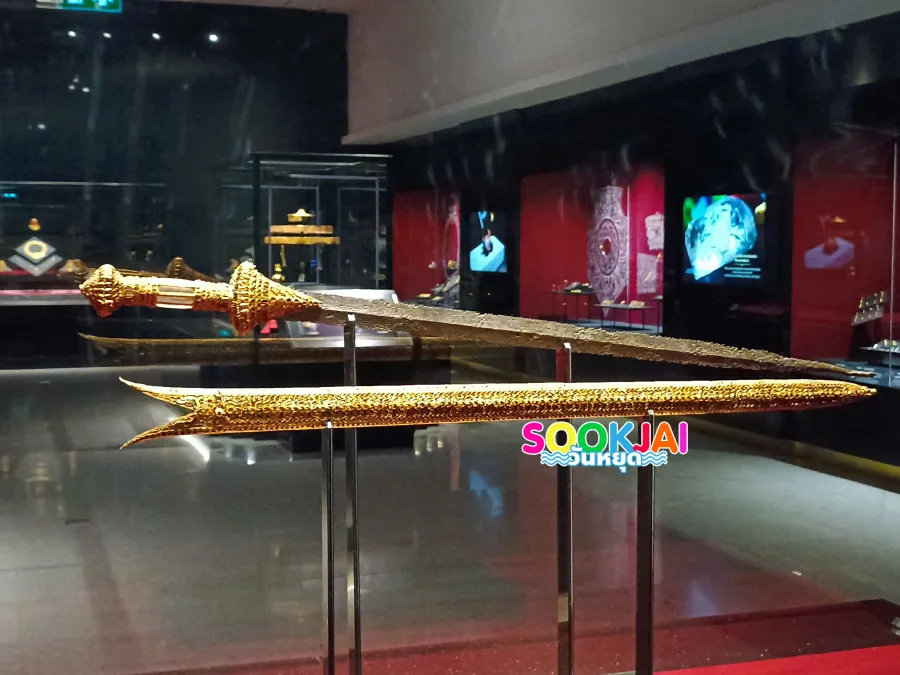
 The Sword of Victory (Phra Saeng Khan Chai Sri), a gold item from the Wat Ratchaburana crypt. Currently on display at the Chao Sam Phraya National Museum.
 Replica of the Royal Elephant (Phra Khachathan), a gold item from the Wat Ratchaburana crypt. Currently on display at the Chao Sam Phraya National Museum.
For other valuable items such as the Sword of Victory (the King's personal sword), replica royal regalia, golden headwear (Phra Mala), royal attire, and exquisite gold utensils of the early Ayutthaya period—which might have been personal treasures of King Sam Phraya or his relatives—most were successfully tracked down and recovered by the police at that time.
The only item missing is the Great Victory Crown (Phra Maha Phichai Mongkut), which vanished without a trace to this day.

The staircase leading down to the crypt inside the prang

An example of the Ruyi (or Yu-ee) pattern on the 2nd level crypt ceiling
📸 Professor Silpa Bhirasri, then Dean of the Faculty of Painting and Sculpture at Silpakorn University, was one of those who participated in inspecting and considering the artistic styles appearing in the Wat Ratchaburana prang crypt. Prof. Silpa wrote that the mural paintings in the 2nd level of the crypt were filled with figures of people, animals, and floral patterns on the walls, all four niches, and the ceiling, which featured jasmine-like circular shapes surrounded by gold-leaf circles, some containing small seated Buddha images. He noted that the use of cinnabar red as a bright background color could enhance the golden glow of the treasures within the crypt, making them shine even more beautifully. Even though the paintings were in a crypt that might never be seen by anyone, the artists still served Buddhism with the most exquisite craftsmanship. Some parts of the crypt walls depicted Jataka tales and the life of the Buddha.
📸 Although Professor Silpa Bhirasri did not mention the paintings in the 1st level of the crypt at all, that level contains depictions of Thai angels (Devas) with Chinese-style decorative patterns. Additionally, there are images of Chinese people wearing hats that look like cooks serving food, as well as images of Chinese officials.
When traveling in Ayutthaya and visiting various temples or ancient ruins, pick up your phone and open the Sookjai Weekend website (easy URL: sookjai.club—add it to your home screen to turn it into a cool travel app). Try typing "Ayutthaya" to find plenty of travel info, accommodation, and delicious food waiting for you. Travel and read to get the most out of your trip!