

 อ่านภาษาไทย
Phuket Thai Hua Museum: Stories from the pioneering era of Phuket's economy, from the saying "Phuket people are lucky to have delightful food." This information comes from the exhibition inside the old building in the middle of Phuket Old Town, built in 1934, which used to be the Phuket Thai Hua Chinese School. That's a good starting point.
.webp)
.webp)
.webp)
.webp)
The Phuket Thai Hua Museum building was originally a Chinese school. The building combines architecture from many eras, including European, Asian, and Chinese. The building has a symmetrical horizontal layout with a gable roof combined with a hipped roof. Notice the bat with outstretched wings on the gable, called Hung Pian Foo, which means that studying is a great fortune. The turtle shell-shaped roof is for the residents to be happy forever (the turtle is an auspicious animal for the Chinese). It is one of the most beautiful buildings in Phuket Old Town.
The Chinese Thai Hua School was founded by several Hokkien merchants in Phuket who were successful in trade through different business methods. They all started by immigrating to Phuket to become tin mine workers and formed the Thai Hua Association to create public benefits for Phuket later on.
.webp)
The picture shows a Chinese printing press that had to be ordered from Singapore in 1967, which the school received as a donation from a merchant to print various types of documents, such as invitation cards and announcements. The school principal assigned a young teacher to use it. It was quite difficult to use because the letters had to be inserted into many slots.
.webp)
In addition to telling the story of the Chinese Thai Hua School, the exhibition also shows models of the lives and activities of members inside the Tiem Chu of the Chinese, which is the shophouse, a residential building that is also used as a shop.
Phuket people are lucky because they can find delicious food. Nhom and Kopi are examples of the diverse food of Phuket, which has been passed down from the mining era. The starch and sugar in the snacks provide energy, while the caffeine in coffee creates alertness and is also the origin of the coffee club.
Locals often eat dried snacks, meaning snacks that are eaten instead of rice, because the Chinese have a variety of skills in using flour to make various snacks, especially snacks to eat with kopi. There are many of these snacks, such as Kai Sai chicken snacks, rope snacks, Kha Pae egg snacks, and Kong Kiao snacks. There are many famous snack shops, such as Keng Tin Shop and Ar-Takkae Shop, which are still open today.
.webp)
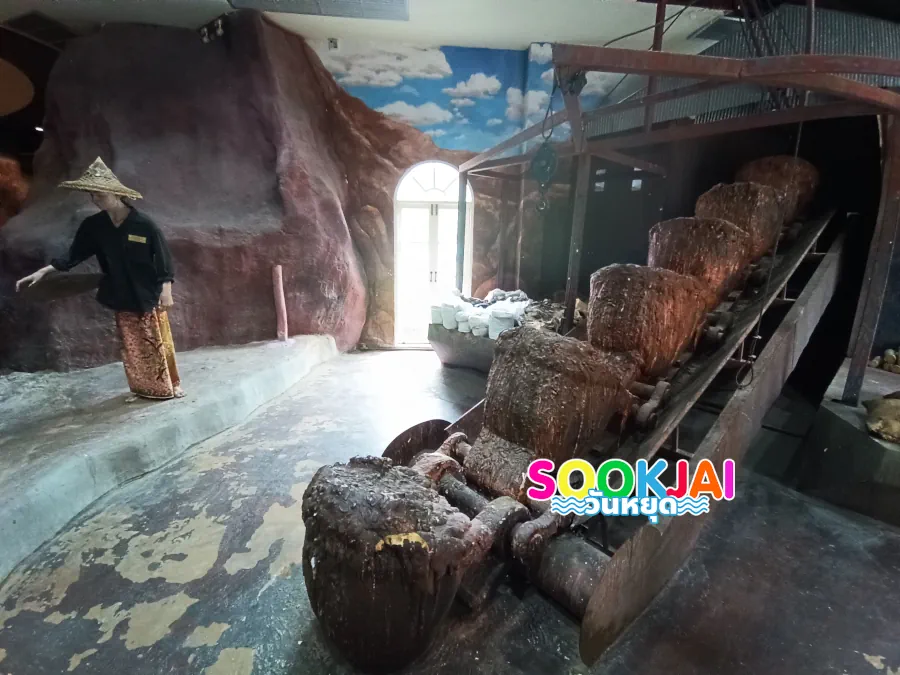
The exhibition helps to create an understanding of the various occupations of Phuket people in the past, such as making wood for mines for the construction of office buildings, and interestingly, including the creation of the world's first ore dredging ship in Phuket by Thung Kha Harbor Company.
Of interest is the story of Ka-lae, a Hokkien Chinese puppet show, with the last player in Phuket being Pae Thao (Thian Sak Ong Phrueksa). It is often played to ask for blessings from the gods, playing a story about the journey home of a top graduate who has been announced as a selectee, so he invites the villagers to perform a ceremony to thank the heavens. There will be three puppets: the Red Face Puppet (Seng Kang Eia), the Top Graduate Puppet, and the Madam Puppet.
For those interested, a video of the Hokkien Chinese puppet show "Ka-lae" by Pae Thao from the Facebook of "Kim Sin - 金身 and History" can be viewed from the link below.
https://www.facebook.com/share/v/14wjTAnzPuF/