

 อ่านภาษาไทย
Visiting the old town of Takua Pa, traveling in Phang Nga, renting a motorcycle to see the old town, and tasting Tao Sor pastries. More than ten years ago, after the tsunami, when I was writing travel stories for books occasionally, I took a bus from Bangkok to Takua Pa district. I walked around looking for the old town for a long time and couldn't find it. The people of Takua Pa told me that I didn't know anything. This is a new town that was moved out later. You have to take a tour bus to the old town first to see a lot of old buildings like in the books I saw. I realized that I had misunderstood from the beginning and had to take a bus to the old town first.
This time, I prepared well, booked a room in Phang Nga province, and rode a motorcycle for a long distance of over 60 kilometers. I rode until my hands were burned (I didn't wear gloves) and arrived at the ancient site of the Takua Pa Governor's Residence in style.


Speaking of which, Takua Pa has a long history. The Milinda Panha scripture mentions a city named Takol (meaning spice, cardamom), which is believed to be the city of Tagola or Takua Pa. This story is about 500 years old, which is believable because around the 7th Buddhist century, the name Takola (Takkola, Tagola) appeared in Ptolemy's geographical records, written by Claudius Ptolemy, a citizen of Alexandria (the city of King Alexander).
Takua Pa is on the Maritime Silk Road, the trade route of ancient states, the Takua Pa - Ban Don Bay (Surat Thani) route. This route starts from Thung Tuk (an international city trading with Persia and China), travels along the Takua Pa River, walks overland across Khao Sok, and sails through Khlong Sok, the Phum Duang River, and the Tapi River to Ban Don Bay.
There are 4 such cross-peninsula routes, all heading to Ban Don Bay. Later, as navigation advanced and trade with the Srivijaya kingdom was desired, sailing around the Strait of Malacca became popular. These cross-peninsula routes lost their importance. As for Siamese documents, the name Takua Pa first appeared during the reign of King Ekathotsarot.


Speaking of the current state of the old town of Takua Pa, there are many ancient buildings called Sino (Portuguese) (some call it Sino-European, Indo-European). A commercial community arose due to the economy from the mining era. The old town of Takua Pa was called Yai Market (divided into Upper Market, Lower Market, North Market, South Market). Later, when the tin ore ran out, the economy deteriorated, and the Phetkasem Road was built around 1950, the prosperity moved to the main road, which helped preserve many old houses in Takua Pa market to this day.

Takua Pa bus stop shelter
Now, the old Takua Pa market has many tourist activities. There is a cultural street or walking street on Sundays from 1:00 PM until the evening. There are restaurants and cafes renovated from old buildings. There are several hotels to serve tourists. Throughout the city, there is street art to take beautiful photos, as well as many ancient sites in Takua Pa district.
Where to go when you arrive in Takua Pa? sookjai holiday invites you to have fun in Takua Pa district. You can have fun in no more than 2-3 hours.

The wall of the Takua Pa Governor's Residence was built by Phraya Sena Nuchit (Nuch Na Nakhon), the governor of Takua Pa in 1840 - 1881, to protect against the Angyee who caused unrest in Takua Pa. The plan of the governor's residence is divided into three parts called the front palace, the hall, and the rear palace. Each part has a connecting door. The walls use the "cast wall" technique (clay, gravel, sand mixed with cement) pressed into rectangular blocks stacked together, reinforced with some thin bricks, without bricklaying. It is found in only a few places in Thailand.
It is assumed that the governor's residence building was made of wood, with factories and warehouses, but it was not orderly. King Chulalongkorn, Rama V, wrote about the Takua Pa Governor's Residence in 1890 (during his visit around the Malay Peninsula) that it was a high-walled house, not very large, with a dilapidated house, not yet finished being rebuilt, where Phraya Sena Nuchit lived. There was an old house behind the main house, no pier, and the factories were quite disorderly.


Wherever there are old houses and old towns, there must be a walking street. Nowadays, it's like they go together. For Takua Pa market, even if you walk on the cultural street on a regular day without any activities, you can still walk around and take pictures because there are restaurants, cafes, grocery stores, souvenir shops, serving tourists just like on days with activities.
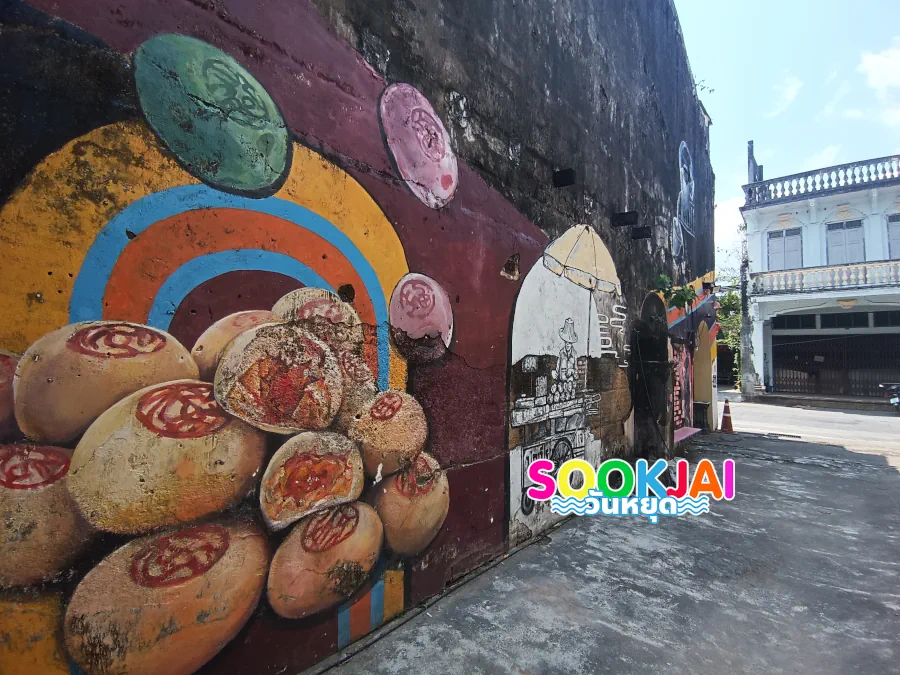


The weather is quite hot for the day that sookjai holiday walks around and takes pictures in Takua Pa district. It's best to have a bottle of water with you to sip when you feel hot. Don't forget to wear a hat, sunglasses, or bring an umbrella. It's a good choice for traveling in a global warming situation.


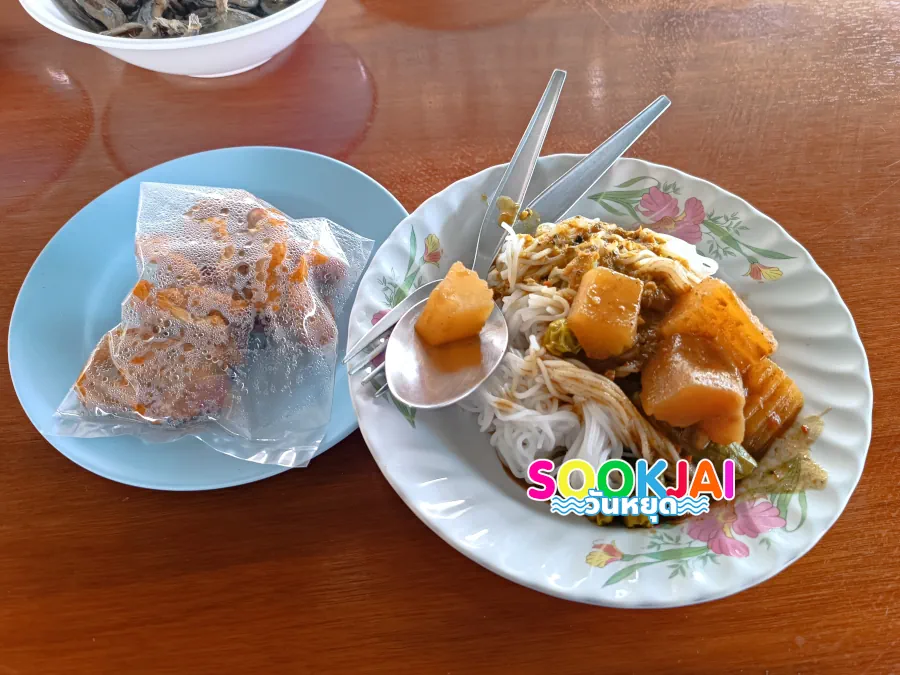
Stop by and eat the most delicious crab curry noodles on Takua Pa Cultural Street. The seller told me that Takua Pa market used to be called Yai Market, divided into 2 zones called Upper Market and Lower Market. Notice how many side dishes there are with southern-style noodles, similar to the noodles in front of the shrine or Pa Son noodles in Phang Nga. But I can tell you that this shop makes very delicious pickled vegetables to eat with the noodles. There are 2 types of pickled vegetables. If you want to know what they are, you have to find a chance to try them.

The Khun In Building or Ban Khun Intharakhiri (Choi Na Nakhon), the grandson of Phraya Sena Nuchit (Nuch Na Nakhon), the governor of Takua Pa and the district chief of Takua Pa, was built by Chinese craftsmen. Currently, it is under the care of the Na Nakhon family. It is an ancient site with architectural value, a modified Sino-Portuguese building. Originally, the roof was covered with turtle-shell tiles. It was renovated according to the original style with corrugated tiles.

The Tao Ming School was founded in 1920 with the support of merchants and wealthy people in Takua Pa, Ranong, and Phuket to be a school teaching Chinese and providing primary education to the children of Chinese people. It was recognized as a private school after the announcement of the Private School Act of 1918. Originally named Toh Beh School in the Hokkien Chinese dialect, it was later changed to Tao Ming, which means leading to knowledge. The school building is in the modified Sino-European architectural style. The building is made of concrete and wood, with a zinc roof. Although the school has been closed for a long time, it has been preserved by the Tao Ming School Foundation, Takua Pa, as a cultural and historical heritage of the community.


Turn on the navigation system and twist the motorcycle throttle to the east, within the city of Takua Pa itself. There is Wat Khuan Tham or Wat Khuha Phimuk located on a not-so-high hill (not tiring to walk up). Here, ancient boundary markers aged 300 years were discovered, according to the temple's information. The newly built viharn is painted in a beautiful light pink color. Inside, there are paintings telling the history of Takua Pa since the mining era. Some pictures also have American superheroes inserted, probably hoping to attract children to visit the temple with their parents and grandparents.


Wat Khiri Khet is the first temple of Takua Pa, built in 1893, starting as a residence for monks and later developed into a temple. It was called by many names such as Wat Khuan Pom, Wat Khuan Chai Khao, Wat Khuan Chedi, Wat Lum, Wat Talat Tai. Currently, the name is Wat Khiri Khet or Wat Phra That Khiri Khet, the place where the relics of the Lord Buddha are enshrined for the city of Takua Pa. Inside the temple, there is a local-style ubosot with a 2-layer roof covered with kite tiles. The building is solid, with doors and windows. The boundary markers are stranger than others, made in the shape of budding lotus flowers. There is a square-shaped ancient mound using the same construction technique as the Takua Pa Governor's Residence. Excavations revealed that it was the base of a pagoda.

sookjai holiday does not miss visiting another important temple in the old Takua Pa market, which is Wat Sena Nuch Rangsan. Reading from the name of the temple, it is not difficult to guess that it was built by Phraya Sena Nuchit (Nuch Na Nakhon), the governor of Takua Pa, in 1847. It was influenced by the Chinese style according to the royal patronage of King Nangklao, Rama III. Originally, the villagers called it Wat Mai Kamphaeng, which was used as a place to hold the oath of allegiance ceremony before the change of government in 1932.

Before leaving Takua Pa district to lean back and relax comfortably in the room in Phang Nga town, sookjai holiday gently twists the wrist. In a few minutes, the trusty motorcycle takes us to Phetkasem Road, straight to the old Takua Pa District Office to take pictures (I didn't take pictures last time, sob). This office building was built in 1929, even before Phetkasem Road was built.


Don't forget another thing, Tao Sor, a good product of Takua Pa market. There may be many shops selling it, but sookjai holiday chose to buy it at Tao Son Nanthawan shop (in the old Takua Pa market). I picked up both boxes to get different flavors, both mixed flavors with salted egg in one box and pure sweet salted egg flavor. It is a famous OTOP product of the subdistrict. When I get back to the hotel, I will lie down and eat until my stomach is full. And sookjai holiday guarantees that it is really delicious.
sookjai holiday travels around Takua Pa and still doesn't cover everything. Riding a motorcycle for half a day still misses some places. For the people of Takua Pa who want to recommend restaurants, cafes, and accommodations that are their own businesses, you can add your service business immediately on our website without any cost.


.webp)


.webp)




.webp)
.webp)